Nocturne - Custom Firmware and Companion App Ecosystem for Spotify Car Thing Hardware
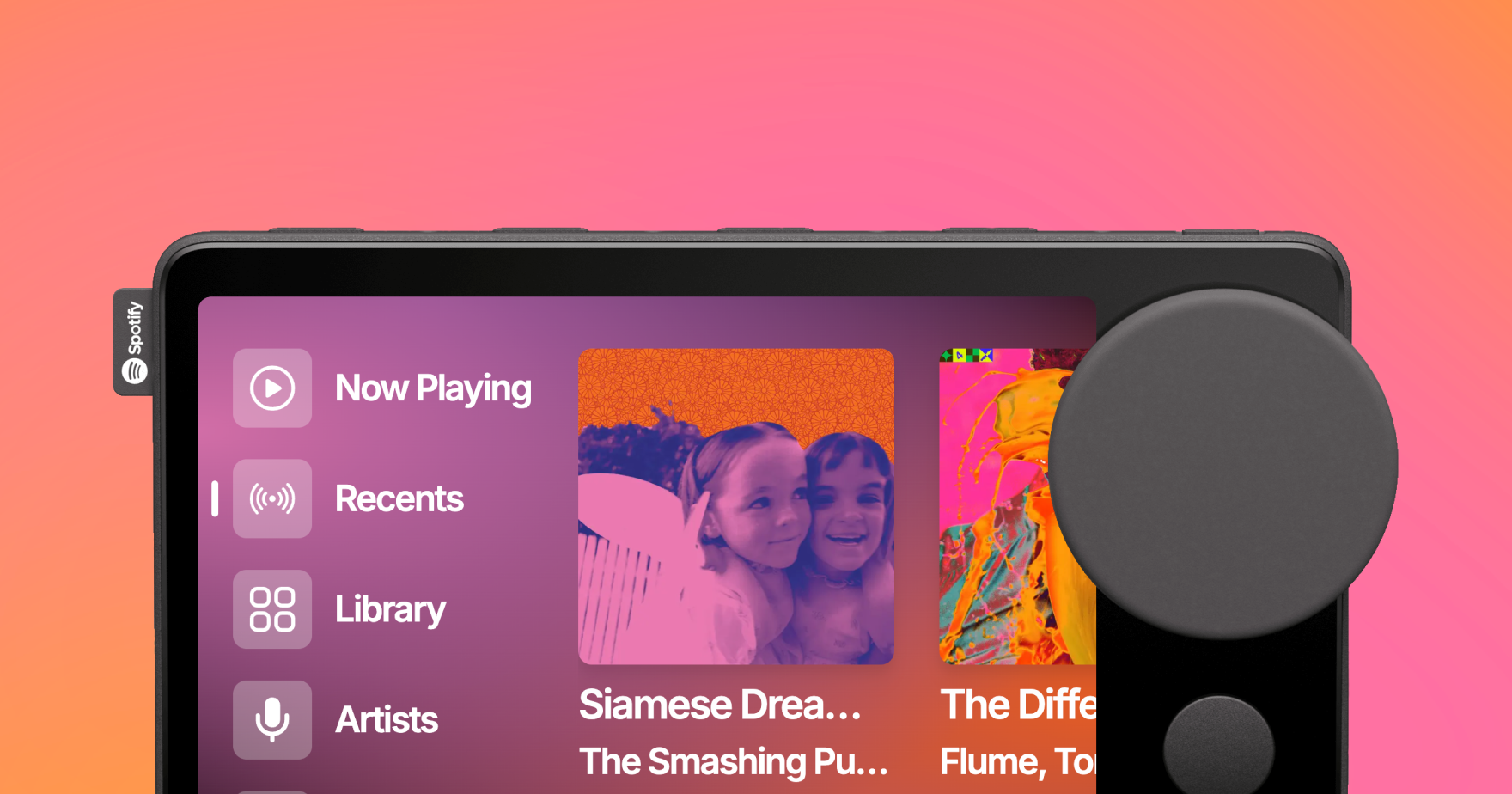
Project Overview: Nocturne is an open-source custom firmware and companion app ecosystem that repurposes the discontinued Spotify Car Thing into a standalone Bluetooth media controller. Built from the ground up by a three-person engineering team, Nocturne replaces the stock firmware with a complete embedded Linux distribution, a real-time Rust system daemon, a touch-optimized web application running on-device, and native companion apps on iOS and Android. With 700+ project sponsors and a community of 1,700+ members, Nocturne is the most advanced custom firmware available for the Spotify Car Thing.
Project History
Nocturne has evolved significantly since its initial release, growing from a simple OS replacement into a full firmware and companion app ecosystem.
v1.0.0-beta.1 - v2.1.1-beta.5 The earliest versions of Nocturne ran a custom Debian 12 configuration on the Car Thing’s hardware. Networking was provided externally via a Raspberry Pi integration - the Car Thing connected to the Pi over USB, which acted as a network bridge, enabling Spotify API communication. While functional, this architecture required users to have a dedicated Raspberry Pi running alongside their Car Thing, creating friction in the setup process.
v3.0.0 A major architectural shift replaced the Debian base with a custom NixOS configuration and eliminated the Raspberry Pi networking dependency entirely. Bluetooth tethering via a phone hotspot replaced the Pi bridge, dramatically simplifying the setup process and making Nocturne accessible to a much wider audience. This release marked Nocturne’s transition from a hobbyist project into a polished, widely-adopted platform.
v4.0.0 (Current) The current generation represents a complete reimagination of the stack. NixOS was replaced with a custom Buildroot-based embedded Linux distribution, giving the team full control over every layer of the OS. A native Rust daemon replaced the previous networking approach, and direct Bluetooth communication between the Car Thing and native iOS and Android companion apps replaced Bluetooth tethering entirely. On-device wake-word detection, A/B OTA update infrastructure, and a fully redesigned React 19 interface round out the most capable version of Nocturne yet.
Architecture
Nocturne is a multi-component ecosystem spanning several interconnected systems:
Firmware The base layer is a custom embedded Linux distribution built with Buildroot, targeting the Car Thing’s ARM Cortex-A53 SoC (Amlogic S905D2) with 512MB RAM. The OS includes the Weston compositor, Chromium in kiosk mode, BlueZ Bluetooth stack, SWUpdate for A/B OTA updates, USB RNDIS gadget networking, and on-device ONNX wake-word inference for “Hey Nocturne” detection.
nocturned (Rust Daemon) The system’s core bridge - a Rust-based daemon managing WebSocket communication on port 5000, BlueZ Bluetooth device management, Spotify API proxying, OTA update orchestration, and overall device lifecycle management. Supervised alongside four other system services.
nocturne-ui (React 19 + Vite) A touch-optimized single-page application running on-device inside Chromium, featuring full Spotify playback control, Bluetooth pairing UI, hardware button mapping, swipe gesture navigation, dynamic album art gradient backgrounds, real-time OTA update flows, and much more.
Companion Apps (iOS + Android) Native mobile apps handling Bluetooth connectivity, Spotify OAuth delegation, phone media control relay, and subscription management. Available on the Google Play Store and iOS TestFlight.
Communication Chain UI → WebSocket → nocturned → Bluetooth → Companion App → Spotify API
Technical Challenges & Solutions
Bluetooth Connectivity Engineering direct Bluetooth communication between the Car Thing and mobile devices was the project’s most significant technical challenge. The solution involved implementing BlueZ-based device management in the Rust daemon with automatic reconnection using exponential backoff and bidirectional media control relay between the embedded device and paired smartphones.
OTA Update Infrastructure Shipping firmware updates safely to devices in the field required building a robust OTA system using SWUpdate with cryptographic signature verification and dual-partition A/B failover, ensuring devices can recover gracefully from failed updates.
On-Device Wake Word Detection Implementing “Hey Nocturne” voice detection within the 512MB RAM constraint required integrating ONNX runtime inference models optimized for the ARM Cortex-A53 architecture.
Hardware Constraints Working within the Car Thing’s original hardware limitations - 512MB RAM, a fixed SoC, and a small touch display - required careful optimization across the firmware, daemon, and UI layers to deliver smooth, responsive performance.
Eliminating External Dependencies Each major version of Nocturne has worked to reduce friction in the setup process - moving from a required Raspberry Pi, to Bluetooth tethering, to direct Bluetooth via companion apps. This iterative simplification was as much an engineering challenge as the underlying technical work.
Technology Stack
- Firmware: Buildroot embedded Linux, kernel 4.9.113, Weston compositor, BlueZ, SWUpdate
- Systems: Rust, WebSocket, Supervisord, ONNX inference
- Frontend: React 19, Vite, TailwindCSS, Chromium kiosk mode
- Mobile: iOS (TestFlight), Android (Google Play Store)
- Hardware: ARM Cortex-A53, Amlogic S905D2 SoC, 512MB RAM
- Version Control: Git, GitHub
Previous Stack (for historical reference)
- v1.0.0 - v2.1.1: Custom Debian 12, Raspberry Pi network bridge, Next.js, TailwindCSS
- v3.0.0: Custom NixOS, Bluetooth tethering via phone hotspot
Project Status
Nocturne is under active development. The project maintains an open-source community of 1,700+ members and 700+ project sponsors. Companion apps are available on the Google Play Store and iOS TestFlight.
The project is open source and available on GitHub.